
News
The Essential XLR to RCA Cable Guide
Bridging Audio Worlds: The Essential XLR to RCA Cable Guide
In the realm of audio, different devices often speak different connection languages. Pro gear prefers the balanced, robust dialect of XLR, while home audio and many mixers converse in the ubiquitous language of RCA. When you need these two worlds to communicate clearly, you need a translator—a specialized cable. The 1 XLR to 2 RCA Cable (in both Female and Male XLR variants) is that crucial diplomat.
But which version do you need, and how do you use it correctly? Let’s untangle the purpose, application, and crucial technical nuances of this indispensable cable.
What Is This Cable?
This is a dedicated interface cable, designed to connect equipment with different output/input types. It features:
- One XLR Connector: This is the 3-pin professional audio connector, renowned for its locking mechanism and balanced signal capability.
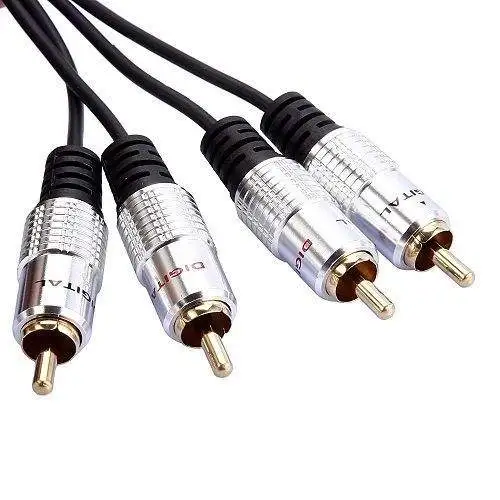
- Two RCA Connectors: The classic red (Right channel) and white (Left channel) connectors for stereo unbalanced audio.
Crucially, it comes in two primary genders:
- XLR Female to 2 RCA Male: Typically used to connect an XLR Output to an RCA Input (e.g., a professional mixer’s output to a home stereo’s input).
- XLR Male to 2 RCA Male: Typically used to connect an RCA Output to an XLR Input (e.g., a DJ controller’s RCA master output to a powered speaker’s XLR input).
The Core Challenge: Balancing Act
This cable exists at the intersection of two fundamentally different signal types:
- Balanced (XLR): Uses three wires (positive, negative, ground) to cancel out noise and interference over long cable runs. Ideal for pro environments.
- Unbalanced (RCA): Uses two wires (signal and ground) per channel. Simpler, but prone to picking up hum and noise over distances.
Connecting them requires an internal wiring scheme that “adapts” the signal. Important: Most simple adaptor cables of this type are “unbalanced,” meaning they tie the XLR’s negative (-) pin to ground. This works in many situations but does not provide true balanced noise rejection.
Primary Use Cases: Where This Cable Shines
Scenario 1: Connecting Pro Gear to Consumer Systems (XLR Female → RCA)
- Example: Taking the balanced XLR master outputs from a live sound mixer, audio interface, or preamp and feeding them into the unbalanced RCA AUX inputs of a home stereo amplifier, powered speakers, or recording device. This is the most common use for the XLR-F to RCA cable.
Scenario 2: Boosting a Consumer Signal to Pro Inputs (XLR Male → RCA)
- Example: Connecting the RCA outputs of a DJ controller, consumer CD player, or smartphone DAC to the balanced XLR microphone/line inputs of powered PA speakers, a stage mixer, or a pro recorder. This uses the XLR-M to RCA cable. It often provides a stronger, “line-level” signal that can travel longer distances to the speaker with less susceptibility to noise after the connection.
Scenario 3: Studio & Home Recording Workarounds
- Example: Integrating a vintage piece of consumer gear (like an RCA-output synth or effects unit) into a pro studio setup with XLR-only preamps, or vice-versa.
Critical Technical & Safety Notes
Using this cable successfully requires an understanding of its limits:
- It Does NOT Convert Balanced to Unbalanced Magically: The resulting signal path from XLR to RCA becomes unbalanced. Keep these cable runs SHORT (under 10-15 feet) to avoid introducing hum.
- Impedance & Level Matching: You are connecting a low-impedance, balanced output (XLR) to a high-impedance, unbalanced input (RCA). This is generally safe and works well, but always start with your output device’s volume/gain at zero and gradually increase to avoid overloading the RCA input.
- Ground Loop Potential: Connecting balanced and unbalanced systems can sometimes create a ground loop, resulting in a persistent 50/60Hz hum. If this occurs, try using a Direct Injection (DI) Box, which is the proper, transformer-isolated solution for this conversion.
- Phantom Power Danger: NEVER plug an XLR-F to RCA cable into a microphone input that has +48V Phantom Power enabled. The phantom voltage can travel down the cable and potentially damage the RCA-output device.
Which Cable Gender Should I Buy?
Use this simple rule:
- Need to plug into an XLR OUTPUT? Use the cable with the XLR Female connector (it receives the output signal).
- Need to plug into an XLR INPUT? Use the cable with the XLR Male connector (it delivers the signal to the input).
Conclusion: A Practical Bridge with Clear Boundaries
The XLR to RCA cable is a pragmatic and essential tool for hybrid audio setups. It solves immediate connectivity problems between studio, stage, and living room gear effectively and affordably.
Think of it as a “get-out-of-jail-free” card for mismatched connections—invaluable for mobile DJs, home studio owners, and content creators. However, respect its limitations: keep cable runs short, be mindful of phantom power, and understand that for permanent, critical, or long-distance installations, a dedicated DI box is the professional’s choice.
Add the correct version to your cable bag, and you’ll never be caught powerless when facing a mix of XLR and RCA ports again.
